What makes a lead magnet actually convert?
It has to deliver a complete result on a narrow problem, fast. Someone hands over an email address expecting a return, and the return has to arrive before their interest fades. A 40 page guide fails this test even when the content is excellent, because it asks for an hour that nobody has budgeted.
Narrowness is the part people resist. The instinct is to make the offer broad so it appeals to more people, which produces a document called something like "The Complete Guide to Growing Your Business" that appeals to nobody in particular. A magnet aimed at one specific situation converts a smaller audience at a far higher rate, and the people it converts are much closer to buying.
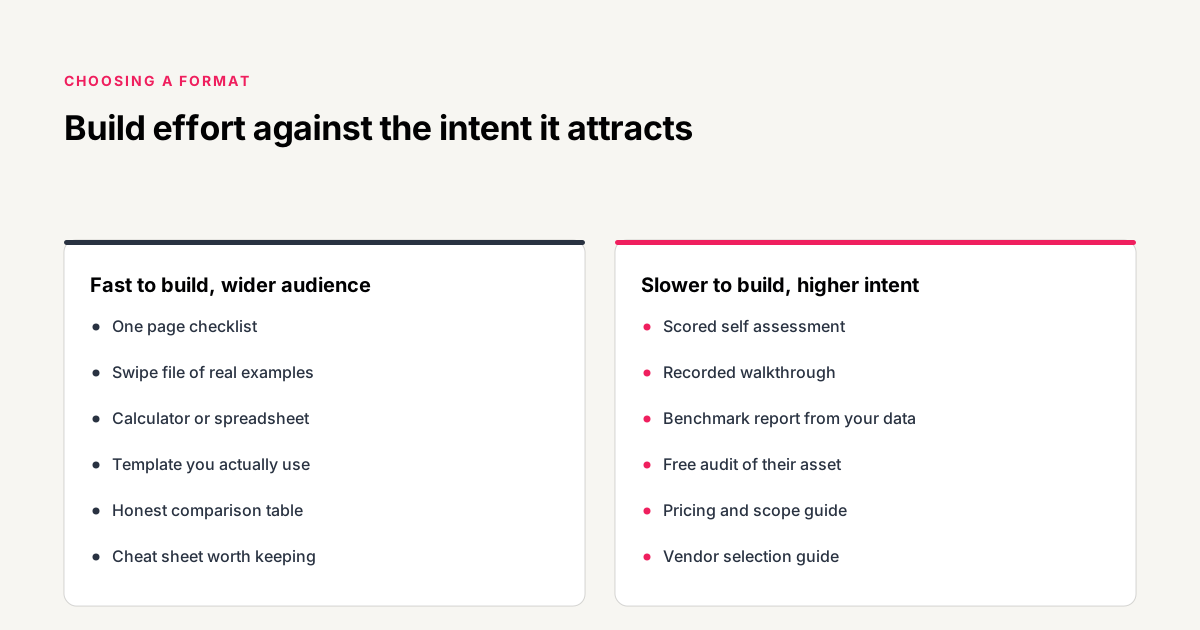
Here is the claim that gets argued with most: your lead magnet should disqualify people. A magnet that everyone in your industry wants will fill your list with peers, students and competitors. A magnet titled for a specific buyer at a specific stage will get fewer downloads and more clients, and the download count is the metric nobody should be optimizing.
Which lead magnets can you build in under two hours?
These are the fastest to produce and they convert well because they are immediately usable. Start here if you have nothing live, because a working magnet built this afternoon beats a perfect one built next quarter.
- 1. The one page checklist. Every step of a process you run for clients, condensed onto a single page. It works because a checklist is scannable rather than readable, which means it gets used during the task instead of being saved for a quieter moment that never arrives.
- 2. The swipe file. Real examples of something your buyer regularly has to write, whether that is subject lines, cold emails or the awkward middle sections of a proposal. Perceived value is unusually high relative to the effort, because you are collecting work you have already done rather than producing anything new.
- 3. The calculator or spreadsheet. A working model your buyer would otherwise have to build themselves, such as a pricing calculator, a runway projection or a returns estimator. Because they enter their own numbers, the output feels personalized without requiring any personalization on your part.
- 4. The template. The actual working document rather than a description of what one should contain, whether that is a contract, a reporting dashboard or a discovery call script. The distinction matters enormously, because a description leaves the reader with the work still ahead of them.
- 5. The comparison table. The realistic options in your market laid out honestly, explicitly including the circumstances in which you are not the right answer. Admitting where a competitor fits better is the fastest way to become credible on everything else you claim.
- 6. The teardown. A genuine example dismantled publicly, showing both what succeeded and what failed, anonymized wherever confidentiality requires it. Analysis of something concrete is consistently more persuasive than advice offered in the abstract.
- 7. The cheat sheet. A reference card covering something your buyer looks up repeatedly and never quite memorizes. Because it gets retained rather than consumed once, your name remains somewhere in their working environment for months afterwards.
Which lead magnets are worth a full day of work?
These take longer but attract buyers with more intent, because engaging with them requires effort that a casual browser will not spend. That effort is the filter.
- 8. The self assessment. A scored diagnostic that tells somebody where they currently stand against a standard you define. People will readily answer twelve questions about their own situation that they would never sit still for as twelve paragraphs of explanation, which is why the format outperforms writing that covers identical ground.
- 9. The mini course by email. Five concise lessons delivered over five consecutive days. The considerable advantage is that follow-up is built into the format itself, so the nurture relationship establishes automatically rather than requiring a separate sequence somebody has to remember to write.
- 10. The recorded walkthrough. Roughly fifteen minutes of you performing the actual work on screen, narrating the decisions as you make them. Inexpensive to produce, genuinely difficult for a competitor to replicate, and considerably more persuasive than any written equivalent.
- 11. The benchmark report. An account of what typical performance actually looks like across your buyer's market, which requires proprietary data you may already possess from previous client engagements. Buyers are persistently uncertain whether their numbers are normal, and resolving that uncertainty is valuable.
- 12. The decision framework. A structured method for choosing between the alternatives your buyer is currently weighing, identifying which criteria genuinely determine the outcome and which merely feel important during the evaluation.
- 13. The audit template. The precise checklist you personally use when evaluating a prospective client, handed over without reservation. Demonstrating the rigor of your evaluation is substantially more convincing than asserting that you are thorough.
- 14. The 90 day plan. A sequenced implementation plan for the outcome your buyer wants, specifying what happens in each phase and, more usefully, what must be finished before the next phase can begin.
Which lead magnets bring the highest intent buyers?
These attract far fewer people, and a much larger share of the people they attract are ready to buy. Use them when you already have traffic and want to convert more of it rather than get more of it.
- 15. The free audit. You review something they already own, whether a profile, a funnel or a set of accounts, and send back specific findings. This attracts the highest intent of any format available, and it is correspondingly the most demanding on your calendar, so it only works while volume remains manageable.
- 16. The teardown request. A considerably lighter version of the audit, where they submit a single URL or document and receive a short recorded review in return. It scales far better than a full audit while retaining most of the qualifying effect.
- 17. The pricing guide. An honest explanation of what work like this typically involves financially, including the variables that move the number. It attracts people who have already moved past whether they need this and are now establishing what it should reasonably require, which is a considerably later stage than most magnets reach.
- 18. The vendor selection guide. An explanation of how to evaluate anyone offering this work, including the questions worth asking and, more valuably, the answers that ought to concern them. Buyers actively searching for this are already committed to purchasing something.
- 19. The scope template. A realistic account of what a project resembling theirs typically encompasses, including the elements consistently underestimated. This reaches people actively planning rather than idly considering.
- 20. The migration or transition plan. Written for buyers moving away from an existing arrangement, covering sequencing and the failures that commonly occur during handover. Extremely specific, and correspondingly qualifying.
- 21. The office hours slot. A short, genuinely unpitched conversation offered openly. It consumes your calendar rather than your production time, but everyone who books has selected themselves, which is the most reliable qualification available.
| Tier | Build time | Volume | Best when |
|---|---|---|---|
| Quick wins | Under 2 hours | High | You have nothing live and need a capture point today |
| Day builds | 1 to 2 days | Medium | You have traffic and want better qualified leads |
| High intent | Ongoing time per lead | Low | You have enough traffic and want more calls from it |
How do you decide which lead magnet to build?
Choose according to which constraint is currently limiting you, because the same magnet that fixes one situation actively worsens another. If almost nobody is arriving at your capture point, your problem is volume, and a demanding format like a free audit will convert a handful of people from an audience that was already too small. If plenty of people are arriving but the resulting conversations go nowhere, your problem is qualification, and adding another quick download simply increases the number of unqualified contacts you have to sort through.
The diagnostic question is uncomfortable but reliable. Look at the last twenty people who joined your list and ask how many of them could realistically afford your engagement and have the authority to commission it. If the honest answer is fewer than five, your magnet is attracting an audience rather than a market, and building a second one in the same register will reproduce the problem at greater volume.
Match the format to the sales cycle
Longer and more considered purchases justify heavier magnets, because a buyer evaluating a substantial engagement is willing to invest time in the evaluation and expects to. Somebody choosing a fractional CFO to rebuild their finance function will happily complete a fifteen question diagnostic, whereas somebody deciding whether to attend a workshop will not. Where the engagement is smaller and the decision faster, a checklist or template that delivers value immediately is proportionate to what is being asked.
There is a corollary that matters for pricing. When your engagement represents a significant investment, the magnet is doing part of the selling, and it should demonstrate the quality of your thinking rather than merely being useful. An audit template that reveals how rigorously you evaluate a problem does more commercial work than a tidy summary of information the buyer could have found elsewhere, even though the summary takes less effort and gets more downloads.
How should you name a lead magnet?
Name the outcome and the constraint, not the format. "Ebook" describes a file type and asks the reader to work out why they should care. "The 7 costly mistakes that keep your audience from becoming clients" names a problem, quantifies it, and implies the fix.
The strongest names carry a number and a timeframe, because both make the promise feel bounded and therefore believable. "Get your books investor ready in 90 days" outperforms "A guide to financial reporting" even when the second document is better, and that gap is worth understanding before you spend a week writing.
- Start with the outcome. What is different after they use it? That is the first half of the name.
- Add the constraint. A number, a timeframe, or a limitation. "In one page", "in 90 days", "without hiring".
- Name the buyer if the outcome is generic. "For agency owners" turns a broad promise into a specific one.
- Cut the format word. Nobody wants an ebook, a PDF or a guide. They want the result.
- Test the name before you build. Put the title on a landing page and drive a little traffic. If nobody opts in for the name, nobody will opt in for the finished thing.
That last step is the one almost everyone skips, and it is the cheapest insurance available. Testing a title takes an afternoon. Building the wrong magnet takes a week and you find out afterwards.
What does the landing page around it need?
One promise, one form, and proof that you can deliver on the promise. Everything else reduces conversion. The most common failure is a landing page that behaves like a homepage: navigation, multiple offers, a footer full of links, and an opt-in form competing with all of it.
Ask for the minimum. Every additional field reduces completion, and most of the data collected on opt-in forms is never used. Email alone is usually correct. A first name is defensible because it personalizes the follow-up. Phone number, company size and job title belong on a later form, once there is a relationship to justify asking.
What happens after the form matters as much as the form. A magnet with no follow-up sequence produces a list rather than a pipeline, which is covered in our guide to the B2B email nurture sequence that books calls. We build the pages and the sequences together for exactly this reason, as part of lead magnets and funnel builds.
What are the most common lead magnet mistakes?
- Making it too broad. A magnet for everyone converts nobody and fills your list with people you cannot help.
- Making it too long. Length signals effort to the person who wrote it and signals work to the person receiving it.
- Gating something freely available. If a search returns the same information in thirty seconds, the trade is not worth an email address.
- No follow-up. The download is the beginning of the relationship, and most people treat it as the end.
- Optimizing for download count. The number that matters is calls booked, and the two often move in opposite directions.
- Featuring it nowhere. A magnet that is not linked from your profile, your site and your content is a file, not a funnel.
The last one is more common than it sounds. A great magnet with no distribution converts nothing, and the fix takes fifteen minutes across your LinkedIn featured section, your site header and your email signature. If the site itself is the weak point, because the pages were designed to look credible rather than to capture anything, that is a separate problem addressed by conversion focused website design.
What does a working lead magnet look like in practice?
Our own is a worked example, and it follows the rules above closely enough to be useful as a template.
The same capture pattern, built into a full acquisition system for a real client, is documented in the NDEWTime Fitness and Nutrition case study.
How do you know if your lead magnet is working?
Measure three numbers, in this order: landing page conversion rate, reply rate to the first follow-up email, and calls booked from the sequence. The third is the only one that matters commercially, but the first two tell you where a problem is when the third is zero.
| Number | Rough benchmark | What a low figure means |
|---|---|---|
| Landing page conversion | 20 to 40 percent from warm traffic | The promise or the title is wrong |
| Reply rate to email one | 2 to 5 percent | The magnet attracted the wrong people |
| Calls booked from sequence | Varies by market | The sequence never asks, or asks too early |
Treat those benchmarks as rough orientation rather than targets, because they move a lot by market and by traffic source. Cold paid traffic converts far below warm traffic from your own profile, and comparing the two produces bad decisions.
Frequently asked questions
How long should a lead magnet be?
Short enough to finish in one sitting, which usually means one to five pages or under fifteen minutes of video. Length is not a proxy for value. A one page checklist someone actually uses beats a 40 page guide they save and never open, and the checklist takes an afternoon to build.
Should you gate a lead magnet or give it away?
Gate it if the goal is building a list you can follow up with, which it usually is for consultants. Give it away ungated if the goal is search visibility and links, since gated content cannot rank. Some pieces are worth publishing both ways, with an ungated web version and a gated download.
How many lead magnets do you need?
One that works. Consultants frequently build four mediocre magnets when one strong one, properly featured and followed up, would produce more. Add a second only when the first is converting and you have a genuinely different buyer segment to serve.
Do lead magnets still work in 2026?
Yes, though the bar has risen. Generic ebooks stopped working years ago because the same content is now available instantly from any AI assistant. What still works is anything specific to the reader's situation, anything involving your own data, and anything that produces a personalized result.
What is a good opt-in conversion rate?
From warm traffic like your own LinkedIn profile, 20 to 40 percent is a reasonable range. From cold paid traffic, 5 to 15 percent is more typical. The gap is large enough that comparing your number against a benchmark from a different traffic source will mislead you.
Should the lead magnet be free?
Free for list building, which is the usual goal. A small paid version filters harder and produces better qualified buyers, but it also collapses volume, so it only makes sense once you have enough traffic that filtering is the constraint rather than reach.
Published . Last updated . 3,174 words.