What is a client acquisition strategy?
It is the defined route from somebody not knowing you exist to somebody sitting on a call with you, together with the assets that move them along it. The word strategy matters because it implies deliberate sequencing rather than an accumulation of tactics that each seemed reasonable at the time.
Most independent experts do not have one, though they would say otherwise. What they have is a collection of activities: posting occasionally, attending events, asking for referrals, answering inbound enquiries. None of it hands off to anything. Activity is not a strategy when each piece terminates rather than feeding the next one. The test is simple. Ask what happens to somebody who reads your best post and is interested but not ready to buy today. If the honest answer is nothing, you have activities.
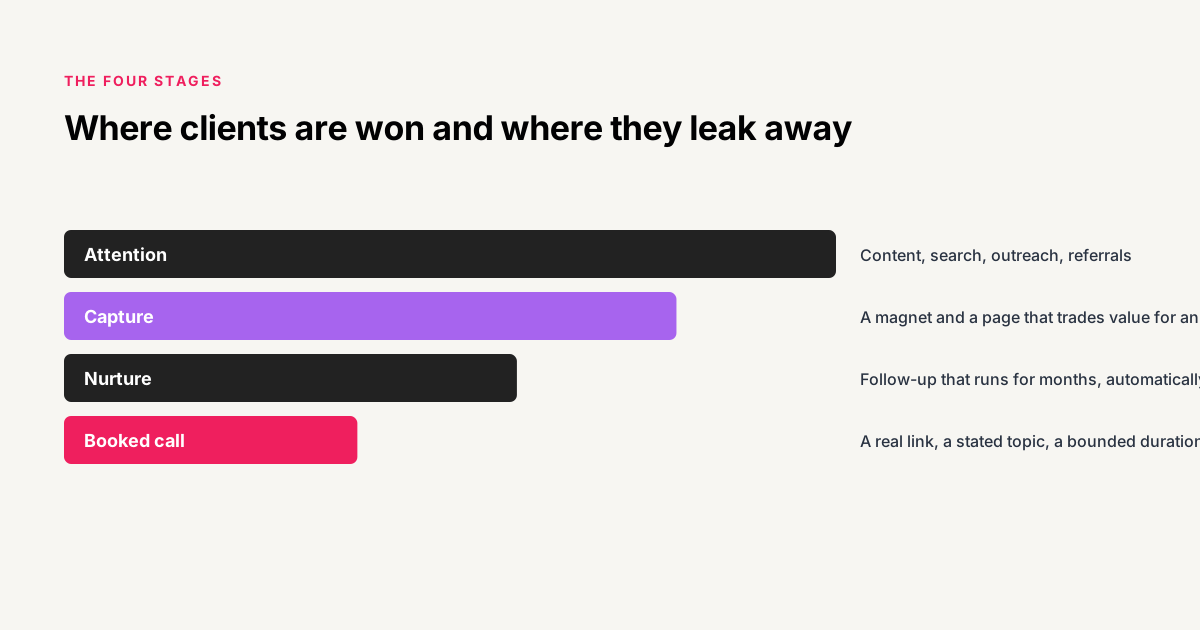
What are the four stages of client acquisition?
Attention, capture, nurture and booking. Each has a different job, a different failure mode and a different fix, which is why diagnosing which one is broken matters more than improving all four simultaneously.
- Attention. Somebody who has your problem becomes aware you exist. Content, search, outreach and referrals all produce attention, and they are interchangeable at this stage in a way they are not later.
- Capture. That awareness converts into contact details you own. Without this stage, every subsequent conversation depends on the person remembering to come back, which most do not.
- Nurture. The contact develops enough trust and urgency to want a conversation. This takes weeks or months for most considered purchases, and it is where the majority of leads are quietly lost.
- Booking. The conversation gets scheduled. Friction here is almost always mechanical rather than motivational, which makes it the cheapest stage to fix.
The stages are strictly sequential. That is the most useful property of the model, because it tells you what not to work on. Improving attention when capture is broken produces nothing except a larger number of people who leave without trace. A great deal of marketing budget is spent every year proving this point. More traffic into a leaking funnel is just more loss, arriving faster.
How do you find which stage is leaking?
Count what actually happens at each transition over the last ninety days, then look for the largest proportional drop. Absolute numbers mislead, because a stage that loses ninety percent of a small input looks less alarming than one losing fifty percent of a large one, while being considerably more broken.
| Symptom | Failing stage | The fix |
|---|---|---|
| Nobody knows who you are | Attention | Content and outreach, consistently, for months |
| Traffic arrives and vanishes | Capture | A lead magnet and a landing page that trades value for an email |
| List grows, nothing books | Nurture | An email sequence that follows up indefinitely |
| Interest but no calendar time | Booking | A real booking link and a bounded, specific offer |
| Calls happen but nobody buys | Not acquisition | Your offer or your qualification, not this system |
That final row deserves emphasis. If people book calls and then consistently decline, no amount of acquisition work helps. Building more of it just fills your calendar with conversations that go nowhere. The problem sits upstream, in what you sell or in who you are allowing to book, and both are worth resolving before you invest in bringing more people to the same outcome.
How do you generate attention that leads somewhere?
Choose one channel where your buyers already congregate and work it consistently for at least ninety days before evaluating. The instinct to be present everywhere produces shallow presence in several places, which underperforms committed presence in one by a wide margin.
For consultants selling to businesses, that channel is usually LinkedIn, because buyers are identifiable, reachable and already there professionally. The detailed mechanics are in our guide to getting clients on LinkedIn. For coaches selling to individuals it is frequently Instagram or search, depending on whether the buyer discovers you or goes looking.
There is a newer consideration that did not exist a few years ago. A meaningful and growing proportion of buyers now ask an AI assistant for recommendations before they search conventionally, which means being findable increasingly includes being citable. That is a distinct discipline covered in our guide to generative engine optimization.
How do you capture attention before it disappears?
Offer something specific enough to be worth an email address, and place it where attention actually lands. Capture fails for two reasons: either the offer is not compelling, or it is invisible from the places people arrive.
The second is more common and much easier to fix. Your capture point needs to be reachable from your social profile, your website, your content and your email signature. That is about fifteen minutes of work. A surprising number of otherwise sophisticated operations have simply never done it, usually because it feels too small to schedule.
How do you nurture leads who are not ready yet?
Automate it, because manual follow-up fails at precisely the volume where it begins to matter. Somebody who downloads a resource today may not have the problem urgently for another eight months, and the only realistic way to still be present at that moment is a sequence that runs without your involvement.
The purpose of nurture is not persuasion so much as presence combined with usefulness. Each message should be worth opening independently of whether the reader ever buys, because that is what keeps the sequence from being unsubscribed before the moment it exists for. The full structure with copy is in our guide to the B2B email nurture sequence.
This is the stage most consultants skip entirely, and skipping it wastes most of the value of the two stages before it. A contact you captured and never followed up with cost you the same effort as one you nurtured, and produced nothing.
How do you remove friction from booking a call?
Use a real booking link, state exactly what the call covers, and bound the duration. Each of those three removes a specific hesitation, and the combination converts substantially better than any of them individually.
- A real booking link. Negotiating times by message introduces multiple opportunities for the conversation to lapse. Cal.com and Calendly both eliminate this entirely.
- A stated agenda. "A call" is ambiguous and therefore postponable. "We map where your client flow is leaking" is a defined deliverable somebody can evaluate.
- A bounded duration. Thirty minutes is a decision somebody can make immediately. An open ended conversation requires clearing an afternoon, which requires a better moment that rarely arrives.
- A qualification step. A short form before the calendar filters out obvious mismatches and, usefully, increases the sense that the time is worth protecting.
That final point is counterintuitive and worth defending. Adding friction deliberately, in the form of a few qualifying questions, generally improves the quality of who books without materially reducing the number of qualified people who complete it. The people deterred by four questions were rarely going to become clients.
How long does a client acquisition system take to work?
Around thirty days to build, and three to six months before it produces predictable results. Anybody promising materially faster is describing outreach in isolation, which does generate conversations quickly but stops entirely the moment somebody stops sending messages.
| Period | What is happening | What you should see |
|---|---|---|
| Weeks 1 to 4 | Building | Assets live, first outreach sent |
| Months 1 to 2 | Warm lists worked | First conversations and calls |
| Months 2 to 4 | Content compounds | Inbound begins, list grows |
| Months 4 to 6 | Nurture matures | Calls from contacts captured months earlier |
That final row is the one that changes a business, and it is also the one nobody sees coming, because it depends on work done months earlier that appeared to produce nothing at the time.
What does a complete system look like for a real client?
Darnell Watkins is an ISSA certified trainer and nutrition coach working with high value professional clients. His constraint was not demand and it was not delivery. It was that finding and following up with the right people consumed the time he wanted to spend coaching.
What is the most common client acquisition mistake?
Working on the stage you enjoy instead of the stage that is broken. Almost everyone does this. It is not laziness, it is that the broken stage is usually the boring one.
Content is enjoyable. It gets likes. You can see it working. Email sequences are tedious to write and nobody applauds them, so they stay unwritten for years while the content calendar fills up. The same pattern shows up with website redesigns, which feel productive and are frequently a way of avoiding the harder question of what happens to a visitor after they arrive.
- Rebuilding the website when capture is the problem. A new design does not add a capture point. Adding a capture point does.
- Posting more when nothing captures. More attention into the same dead end.
- Buying a course on a stage that already works. The comfortable choice, and the least useful one.
- Switching channels every few weeks. Ninety days is the minimum before a channel has told you anything.
- Measuring the wrong thing. Followers, impressions and downloads all move independently of booked calls, and sometimes inversely.
The discipline is to diagnose first and then work on whatever the diagnosis produces, even when that turns out to be the least interesting task available. Most of the time it will be.
Should you build this yourself or have it built?
Build it yourself if you have the time and enjoy the work. None of the individual components are technically difficult. Anyone can write a landing page or set up a sequence. The real difficulty is maintaining all four stages at once while also delivering client work, and that is where most self built systems quietly degrade, usually around month three when a large project lands.
The honest comparison is between what your time is worth delivering billable work and what the system requires monthly to keep running. A system built once and then neglected returns to producing nothing within a couple of months, which is the outcome that makes the initial investment look wasted when the actual failure was the operating.
If having it built and then operated is the right answer for you, that is precisely what our full client acquisition system is. It is built once across roughly thirty days, then run every month with reporting.
Frequently asked questions
What is the difference between lead generation and client acquisition?
Lead generation is the capture stage only. Client acquisition covers all four stages, from attention through to a booked call. The distinction matters. Generating leads into a system with no nurture and no booking produces a growing list and no new revenue. That is a common outcome and an expensive one.
How much should you invest in client acquisition?
Judge it against the value of one client, not against a percentage of revenue. Say a client is worth twenty thousand over the engagement. A system that reliably adds two clients a year is then easy to justify. The real comparison is what the same outcome would cost you in your own hours.
Do you need paid advertising?
Not for most consultants and coaches. Paid ads increase attention, and attention is rarely the failing stage. Ads also amplify whatever the rest of the system already does. Run paid traffic into weak capture and no nurture and you will conclude that ads do not work in your market. They worked fine. The funnel did not.
Can referrals be a client acquisition strategy?
Referrals are an excellent source of attention. They are a poor strategy on their own, because you control neither the volume nor the timing. Treat referrals as one attention channel among several, feeding the same capture and nurture stages as everything else.
How many clients can this realistically produce?
That depends on your market size, your price and your sales cycle. Those vary too widely for a useful general number. A better question is what share of the attention you already get converts today. For most consultants that number is very low, and improving it by several times over is realistic.
What if you have no audience at all yet?
Build capture and booking first, then work the warm lists you already have, including past clients, dormant conversations and existing contacts. Building content and outreach before there is anywhere for interest to go repeats the most common mistake, just earlier in the process.
Published . Last updated . 2,558 words.