What is an email nurture sequence for?
It exists to be present when somebody becomes ready, which is almost never the day they downloaded something. A person grabs your guide because the problem is on their mind. They are not necessarily in a position to hire anyone. The sequence keeps you around until they are.
That framing changes what the emails should contain. If you assume readiness, you write a pitch and it fails. If you assume the reader is interested but not urgent, you write something useful, and usefulness is what earns the right to still be in the inbox in eight weeks.
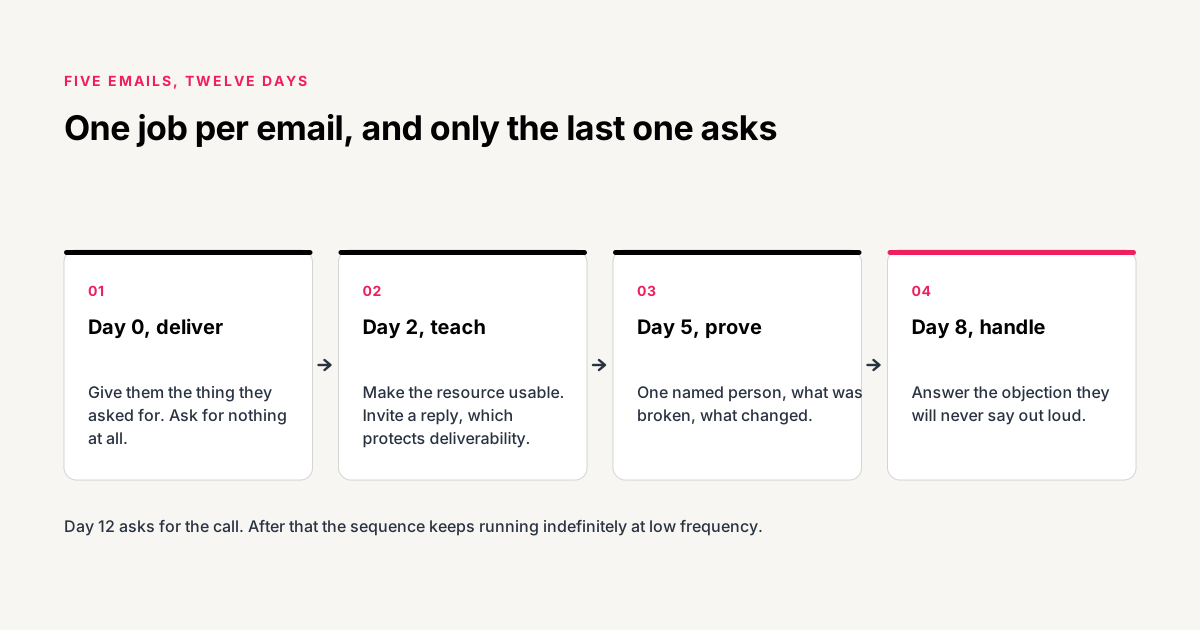
Here is the position that gets argued with: most consultants should send fewer emails and ask later. The instinct when a lead goes quiet is to increase frequency and add urgency. That reliably produces unsubscribes from people who would have bought in four months.
What should the five emails actually do?
Each one has a single job, and the jobs are ordered by how much trust they require. Delivering something requires none. Asking for time requires quite a lot.
| Send | Job | Asks for | |
|---|---|---|---|
| 1. Deliver | Immediately | Give them the thing | Nothing |
| 2. Teach | Day 2 | Make the resource usable | A reply, optionally |
| 3. Prove | Day 5 | Show it works for someone real | Nothing |
| 4. Handle | Day 8 | Answer the silent objection | Nothing |
| 5. Ask | Day 12 | Offer a specific conversation | The call |
Note that three of the five ask for nothing at all. That ratio is deliberate. A sequence where every email asks trains the reader to stop opening, and open rate is the resource the whole thing depends on.
Why the ordering is what it is
The sequence is arranged so that each message requires slightly more of the reader than the one before it, which permits trust to accumulate rather than assuming it exists at the outset. Delivering a resource somebody explicitly requested requires nothing of them and consequently cannot fail. Requesting thirty minutes of a stranger's time requires a considerable amount, and requesting it prematurely converts a warm contact into an unsubscribe.
Reordering the sequence to bring the ask forward is the most common modification people make, generally after a fortnight during which nobody has booked anything. It reliably produces a small number of additional bookings in the immediate term and a substantially smaller list thereafter, which is a poor exchange for an offer whose buyers typically take months to reach the point of readiness.
What makes a nurture subject line work?
Specificity, and an accurate relationship to what is inside. A subject line's job is not to maximize opens in isolation. It is to attract the opens that lead to the message being read rather than immediately closed, and those two objectives diverge considerably more than most people expect.
Curiosity gaps demonstrably increase open rates and simultaneously erode the credibility that makes later messages effective. A recipient who opens something promising a revelation and finds ordinary advice has learned something durable about the reliability of your subject lines, and that lesson persists across every subsequent send.
| Weak | Better | Why |
|---|---|---|
| Following up | The 20 minute version | Describes the contents |
| Quick question | Worth 30 minutes? | States the actual ask |
| Newsletter #14 | He had the credentials and no enquiries | Concrete and specific |
| Don't miss out | "I don't have time to post daily" | Names a real objection |
| Checking in | One thing to fix this week | Promises something usable |
Lowercase and sentence case both outperform title case for this kind of sending, largely because they resemble correspondence rather than marketing. Keep the length under about fifty characters so that mobile clients display the whole thing.
What should the first email say?
Deliver the thing immediately and get out of the way. This email has the highest open rate you will ever get, and the temptation is to use that attention to introduce yourself at length. Resist it. The reader wants the resource they just asked for.
Three things are doing work there. The link appears above everything else, so nobody has to hunt for it. Pointing at one specific section increases the chance the resource actually gets used, and a resource that gets used is what makes the rest of the sequence welcome. And flagging the unsubscribe reduces spam complaints, which protects deliverability for everyone else on the list.
What goes in the second email?
Make the resource easier to act on, and open a door for a reply. Most people downloaded your guide and have not opened it. This email is the nudge that converts a download into an actual read.
That closing question is the most valuable line in the sequence. Replies tell you what people actually want, they improve deliverability because inbox providers treat replies as a strong positive signal, and every reply is a conversation that did not require a pitch to start.
How do you use the third email to build proof?
Tell one specific story about one named person, including what was broken. Generic proof persuades nobody. "We help clients get results" is noise. A named individual with a recognizable situation is evidence.
The detail that makes this work is naming what was wrong. A story where everything was terrible and then became wonderful reads as advertising. A story where something competent had one specific structural flaw is credible, and it lets the reader recognize themselves in it.
What objection should the fourth email handle?
The one they will never say out loud. For most consulting offers that is not price. It is the suspicion that this worked for somebody whose situation was different from theirs, or that it will require more of their time than they have.
Answering an objection before it is raised does something a reply cannot. It removes the reason not to book without the reader having to admit they had one, which is the version of the conversation that does not feel like a negotiation.
How should the fifth email ask for the call?
Name the topic, name the duration, and give a link. Vagueness is what makes an ask easy to postpone. "Want to jump on a call?" invites a decision with no information in it.
The closing line matters more than the ask. Explicitly permitting the reader to not book removes the pressure that causes unsubscribes, and it keeps somebody on the list who might book in eight months. Most sequences end by escalating, which converts a few people now at the price of everybody later.
What happens after the fifth email?
The sequence keeps going, indefinitely, at a much lower frequency. This is the part almost everyone omits, and it is where most of the eventual revenue comes from. A five email sequence that stops on day twelve has abandoned everyone whose problem becomes urgent in month four.
- Move them to the regular list. One useful email every week or two. No sequence, no escalation, just something worth reading.
- Tag by behavior, not by guesswork. Anyone who clicked the calendar link and did not book is in a different position from somebody who never opened anything.
- Re-offer occasionally, not repeatedly. Once a quarter is plenty. The link should be present, not pushed.
- Re-engage the quiet ones twice a year. A single message asking whether this is still relevant. Some will say yes, some will unsubscribe, and both outcomes are useful.
This is the argument for automating the whole thing rather than sending manually. Manual follow-up works at ten contacts and collapses at a hundred, which is roughly the point at which the list starts being worth something. We build and then operate these as email nurture and automation.
How do you keep the sequence out of the promotions tab?
Inbox placement is determined largely by engagement signals accumulated over time, rather than by any individual characteristic of a message, which means the practical levers are structural rather than cosmetic. Providers are inferring whether recipients genuinely want your messages, and they infer it from behavior that is difficult to fake.
Replies are weighted unusually heavily, because a reply is expensive to manufacture and therefore reliable as evidence of a real relationship. This is the underlying justification for the question in email two, which serves deliverability at least as much as it serves the conversation it occasionally produces.
- Authenticate the sending domain. Configure SPF, DKIM and DMARC properly before sending anything at volume. Providers increasingly treat unauthenticated bulk mail as presumptively unwanted.
- Send from a person, not a department. A named human sender consistently outperforms a generic address, both in placement and in whether anyone opens it.
- Remove unengaged contacts periodically. Continuing to send to somebody who has ignored twenty consecutive messages actively damages placement for everybody else on the list.
- Avoid link-heavy templates early. Messages consisting largely of images and tracked links resemble promotional broadcasts, because that is predominantly what they are used for.
- Keep the unsubscribe genuinely obvious. Recipients who cannot find it use the spam button instead, which is considerably more damaging than losing them.
The compounding consequence is worth stating plainly. A sequence that consistently generates opens and occasional replies gradually improves placement for every subsequent message, whereas one that accumulates deletions degrades it for messages that would otherwise have performed perfectly well. Deliverability is therefore a property of the relationship rather than of any particular email.
What makes nurture sequences fail?
- Asking in email one. The highest open rate of the sequence, spent on the request requiring the most trust.
- Sending only when you want something. The list learns that your name means a pitch and stops opening.
- Writing about yourself. Company news is interesting to the company.
- Stopping after the sequence ends. Abandons everybody whose timing was not the first twelve days.
- Automating without personalizing. A first name token is not personalization. Segmenting by what somebody downloaded is.
- Optimizing for open rate. Clever subject lines raise opens and lower trust when the email does not match them.
The sequence is one stage of a longer path, and it only works if something is capturing contacts to feed it. That is covered in our guides to lead magnet ideas and client acquisition strategy. The Ed Perez Fitness case study shows a sequence running inside a complete system, and the full client acquisition system is us building all four stages together.
Frequently asked questions
How many emails should a nurture sequence have?
Five is enough for most consulting offers, spread over ten to fourteen days. What matters more than the count is what happens afterwards. A five email sequence followed by nothing performs worse than three emails followed by a regular newsletter that keeps arriving.
How often should you send nurture emails?
Every two to three days during the sequence, then every one to two weeks afterwards. Daily is too much for a considered B2B purchase and produces unsubscribes from people who were interested but not urgent. Monthly is too infrequent to be remembered.
Should nurture emails be plain text or designed?
Plain text, or close to it, for consulting and coaching. It looks like a message from a person rather than a campaign, it renders reliably everywhere, and it tends to reach the primary inbox more often than a heavily designed template. Save the design for genuine newsletters.
What is a good open rate for a nurture sequence?
For a list built from your own lead magnet, 35 to 55 percent on the first email and 20 to 35 percent later in the sequence is a reasonable range. Treat these as orientation rather than targets, since list source affects them more than copy does.
Should you use a tool or send manually?
Use a tool. Manual sending works until about ten contacts and then quietly stops happening, usually during a busy delivery month. MailerLite, ConvertKit and Kit all handle this well and inexpensively at the volumes most consultants operate at.
What if nobody replies to any of it?
Check the source before rewriting the copy. Silence usually means the magnet attracted the wrong people rather than that the emails are bad. If those contacts were never going to buy, better writing will not change the outcome, and the fix belongs one stage earlier.
Published . Last updated . 2,877 words.