What is generative engine optimization?
GEO is the work of becoming the answer an AI assistant gives when somebody asks for a recommendation in your category. When a founder types "who should I hire to fix my LinkedIn presence" into ChatGPT, something decides which names appear. GEO is the discipline of influencing that.
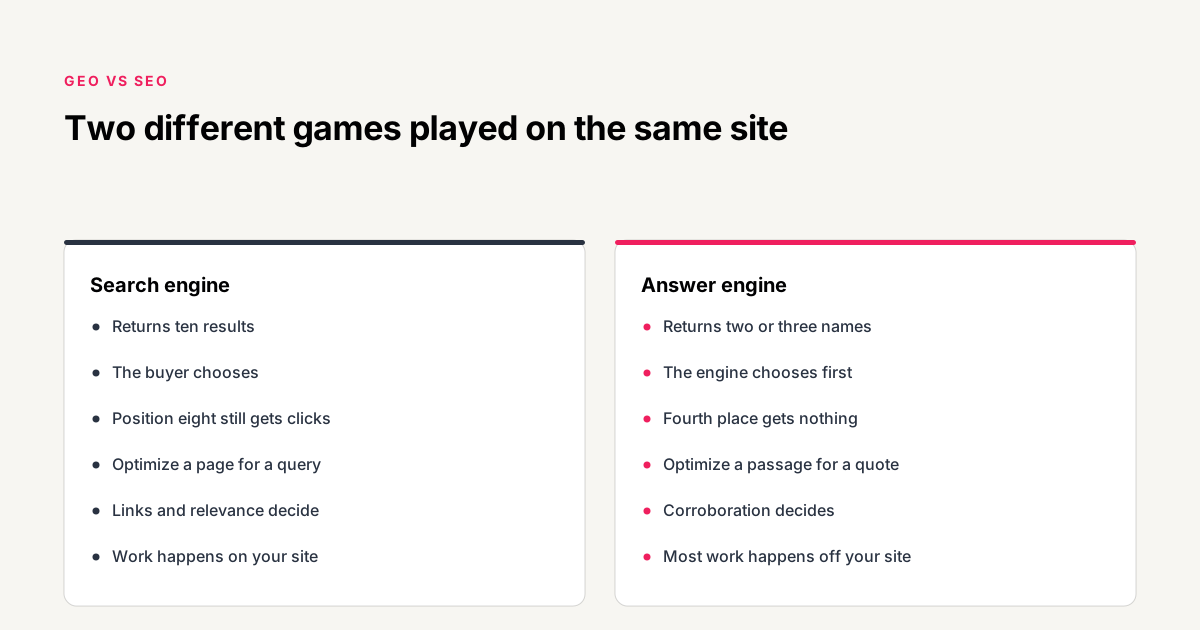
The shift matters because of what it removes. A search results page shows ten options and lets the buyer choose. An answer engine returns two or three names, and the rest of the market is invisible. There is no second page. Being eleventh in search still gets occasional traffic. Being fourth in an answer gets nothing.
How is GEO different from SEO?
They share a foundation and diverge sharply above it. Both need a crawlable site with clear content. After that, SEO optimizes a page to rank for a query, while GEO optimizes a passage to be quoted and an entity to be trusted. The unit of optimization changes from the page to the paragraph.
| SEO | GEO | |
|---|---|---|
| What you optimize | A page for a query | A passage for a quote |
| What wins | Ranking position | Being named in the answer |
| Runner-up prize | Some traffic at position 8 | None |
| Key signal | Links and relevance | Corroboration across sources |
| Where the work happens | Mostly on your site | Mostly off your site |
| Measurement | Rankings and clicks | Whether you get mentioned |
That fifth row is the one people find hardest to accept. Most of GEO is not on your website. An answer engine will not name a company that exists in only one place, no matter how well that one place is written, because a single self-published source is exactly what a model is trained to discount.
How do AI crawlers actually read your site?
They fetch the raw HTML and parse what is there. Most do not run JavaScript. GPTBot, ClaudeBot, PerplexityBot and CCBot request a URL and read the response, so anything your site renders after hydration does not exist to them.
This is the single most common technical failure, and it is invisible from a browser. A site can look complete to every human visitor while serving an almost empty document to the crawlers that decide whether you get cited. Testing it takes one command.
What makes a passage quotable by an answer engine?
It has to stand alone. An engine lifting a paragraph out of your page cannot bring the surrounding context with it, so any passage that depends on the previous three paragraphs is unusable. Self-contained answers get quoted. Well-written prose that builds an argument across a page does not.
- Name the entity in the passage. "Ivoscale builds client acquisition systems" survives extraction. "We build them" does not, because the pronoun loses its referent.
- Answer in the first two sentences. A paragraph that opens with context and reaches the answer in sentence five gets truncated before the useful part.
- Phrase headings as questions. They match the shape of what people actually ask, which makes the passage beneath them easier to select.
- Use real tables. A semantic table with header cells gets extracted with its structure intact. A grid of styled divs loses the relationship between rows and columns.
- Attach dates and sources to claims. A specific, attributed statement is safer for an engine to repeat than a confident unsourced one.
There is a useful test. Copy any paragraph from your site, paste it somewhere with no context, and read it. If it is still a complete and attributable answer, it is quotable. If it needs the page around it, it will never be quoted.
What technical work does GEO require?
Less than most agencies claim, but it has to be right. The technical layer is a prerequisite rather than an advantage, which means doing it well gets you considered and does not by itself get you cited.
- Serve content in the initial HTML. Everything else depends on this. If the crawler cannot read it, nothing downstream matters.
- Allow the AI crawlers in robots.txt. Name GPTBot, ClaudeBot, PerplexityBot, Google-Extended and the rest explicitly. Some CDNs block them by default, which is worth checking rather than assuming.
- Publish structured data that resolves. An Organization node, Person nodes for the founders, and cross references by identifier so an engine can tell that the people and the company are related.
- Publish llms.txt and a full text version. A plain text map of the site, and the complete content in one document, so a retrieval system does not have to reconstruct your site from HTML.
- Offer markdown versions of key pages. Serve markdown at a .md URL and by content negotiation. It removes the parsing step entirely.
- Keep facts identical everywhere. One founding date, one description, one contact address, byte for byte, across your site and every external profile.
That last item does more work than it appears to. Entity resolution is the step before content retrieval, and inconsistent facts across sources is the most common reason an engine declines to name a company: it cannot determine which version is true, so it avoids the claim.
Why does corroboration matter more than your website?
Because a model has been trained to distrust a single self-published source, which is the correct behavior. Anyone can write that they are the leading provider in their category. That statement carries almost no weight arriving from the company's own domain and considerable weight arriving from four independent places that agree.
This is the uncomfortable part of GEO and the reason it cannot be bought as a purely technical service. Here is the honest split: the work on your own site is perhaps twenty percent of whether you get named. The remaining eighty percent is whether other sources corroborate that you exist and are good at something specific.
| Source | Why it counts | Effort |
|---|---|---|
| Verified review platforms | Third party verified, structured | Moderate |
| Company database profiles | Establishes the entity exists | Low |
| Podcast appearances | Named, transcribed, indexed | Moderate |
| Guest articles | Attributed expertise on another domain | Moderate |
| Genuine community answers | Unpaid, contextual mentions | Ongoing |
| Your own website | Necessary, not sufficient | One-off |
Notice that the highest effect items are all off your own domain. Any GEO service that consists entirely of on-site work is selling you the prerequisite and calling it the outcome.
What kind of content gets cited most often?
Content that answers a question completely and can be checked. Answer engines are cautious about repeating claims they cannot verify, so anything specific, dated and attributed is safer to cite than anything sweeping.
Four formats do disproportionately well. Comparisons, because buyers ask engines to compare things constantly and few companies write honest comparisons. Definitions, because a clear one-paragraph explanation of a term is exactly the shape of an answer. Processes with numbered steps, which survive extraction intact. And original data, which nothing else can substitute for.
That last one is the strongest and the least common. If you have data nobody else has, from client work or your own operations, publishing it makes you the only possible source for a whole class of question. A benchmark nobody else has measured cannot be paraphrased from a competitor.
What consistently does not get cited
- Thought leadership with no specifics. Opinion with nothing checkable in it gives an engine nothing to repeat.
- Content that only exists as a video or a PDF. If the text is not in the HTML, the argument is invisible.
- Pages that answer the question halfway down. Extraction takes the top of a section, so a buried answer is a missing one.
- Anything that contradicts your other pages. Two different founding dates on one site is enough to make an engine avoid the whole entity.
What are the most common GEO mistakes?
Treating it as a checklist that finishes. The technical items do finish, and that is the trap: a business completes the setup, sees no citations, and concludes GEO does not work. What actually happened is that they built the prerequisite and stopped before the part that produces the result.
- Blocking the crawlers by accident. Usually at the CDN rather than in robots.txt, and almost always unnoticed. Check both.
- Publishing schema that contradicts the page. A rating in the markup that appears nowhere in the visible content is worse than no rating.
- Claiming an aggregate rating you cannot substantiate. Self-declared scores from unverified reviews are both a policy problem and a credibility one.
- Optimizing one page instead of the entity. Engines resolve who you are before they retrieve what you wrote.
- Expecting results in weeks. Retrieval engines respond quickly. Everything else takes months.
- Ignoring the profiles you already have. An abandoned directory listing with an old description actively contradicts your current site.
The last one is worth acting on this week because it is free. Find every profile that mentions your business, and make the description and the founding details match your site exactly. Contradiction is more damaging than absence.
How do you measure whether GEO is working?
Ask the engines directly, on a schedule, and record what they say. There is no ranking report for this. The practical method is a fixed list of the questions your buyers actually ask, run monthly across ChatGPT, Perplexity, Gemini and Google AI Overviews, with the answers logged.
Track three things: whether you are named at all, what you are named for, and who is named alongside you. The second is often more useful than the first, because being cited for the wrong specialty is a positioning problem rather than a visibility one.
Watch referral traffic too. Visits with a referrer from an AI assistant are small in volume and unusually high in intent, because the person arrived on a recommendation rather than a list of options.
Why the same question gives different answers
Answer engines are not deterministic. Ask the same question twice and you can get two different sets of names, which makes a single check almost meaningless. This surprises people who are used to rankings being stable enough to screenshot.
The practical response is to sample rather than to spot-check. Run each question three times, in a fresh session with no history, and record how often you appear rather than whether you appeared. A business named in one run out of three is in a genuinely different position from one named every time, and a single check cannot tell those apart.
Is GEO worth doing for your business?
It depends mostly on how your buyers decide. GEO pays off fastest where the purchase is considered, the category is unfamiliar to the buyer, and there is no obvious default provider. Those are exactly the conditions under which somebody asks an assistant for a recommendation instead of searching.
Consulting, coaching, fractional executive work and professional services all sit squarely in that description. A buyer who has never hired a fractional CFO does not know what good looks like, so they ask. A buyer replacing a known commodity usually does not.
It is less urgent if you sell something people already search for by name, or if your pipeline is genuinely full from referrals and you have no interest in growing it. Being honest about that is more useful than treating every channel as mandatory.
How long does GEO take to work?
The technical layer takes days and starts mattering as soon as crawlers next visit. Corroboration takes months, because it depends on other people publishing things, and you control the pace of that only partly.
A realistic expectation is that a site becomes properly readable within a week, appears in retrieval-based answers like Perplexity within weeks, and becomes a name that surfaces reliably across engines over six to twelve months. Anything faster is either a very uncompetitive category or an overstatement.
There is a distinction worth holding onto here. Retrieval-based engines search live and can find you quickly. Training-based recall changes only when models are retrained, which is slow and outside anyone's control.
Where should you start with GEO?
Check whether crawlers can read your site, then fix your entity data, then start collecting third-party corroboration. That order matters, because corroboration pointing at an unreadable site wastes the corroboration.
For most businesses the first two take a couple of weeks and the third is a ninety day project that never entirely finishes. Our guide to getting recommended by ChatGPT covers the practical sequence in more detail, and the GEO and AI search visibility service is us doing it.
One caution about sequencing. GEO is a visibility layer, and visibility without a path to a booked call produces interested strangers rather than clients. If your capture and follow-up are not yet built, that is the more urgent problem, and it is covered in our guide to client acquisition strategy and in the full client acquisition system. The Ed Perez Fitness case study shows the order we build things in and why.
Frequently asked questions
Is GEO just a rebrand of SEO?
No, though they share a technical foundation. SEO optimizes a page to rank among ten results. GEO optimizes a passage to be quoted and an entity to be trusted, in a context where only two or three names appear and there is no second page. The overlap is real but the objective is different.
Does GEO replace SEO?
Not yet, and possibly not ever. Conventional search still drives far more traffic for most businesses. The sensible position is that GEO is an additional channel worth building now because it is early and uncontested in most categories, not a replacement for something that still works.
Can you pay to appear in ChatGPT answers?
Not as a ranking placement in the way search ads work. The engines are experimenting with advertising formats, but organic citation is currently earned through corroboration rather than bought. Anyone offering guaranteed placement in AI answers is describing something that does not exist.
Do AI crawlers respect robots.txt?
The major ones from OpenAI, Anthropic, Google and Perplexity document that they do, and blocking them is a reliable way to be excluded. Check your CDN as well as your own file, since some providers add restrictive rules for AI crawlers by default without making that obvious.
What is llms.txt?
A plain text file at the root of your site that describes what the site is and links to its key pages, similar in spirit to a sitemap but written for language models rather than crawlers. It is a proposed convention rather than a standard, and it costs very little to publish.
Does GEO work for local businesses?
Yes, and often better than for national ones, because local queries have fewer credible candidates and a well-maintained business profile carries substantial weight. Consistency between your site and your business listing matters more here than anywhere else.
Published . Last updated . 2,791 words.