Why do you get profile views but no clients?
Because views and clients are separated by four steps, and most consultants have only built one of them. Someone sees your post, visits your profile, decides whether you are relevant, and then either leaves or finds a way to talk to you. A profile view is the second step of four. Getting more of them does nothing if steps three and four do not exist.
This is why posting harder rarely fixes the problem. You are increasing the volume at the top of a path that terminates in a dead end. Two hundred views into a profile with no clear offer and no way to book produces the same result as twenty.
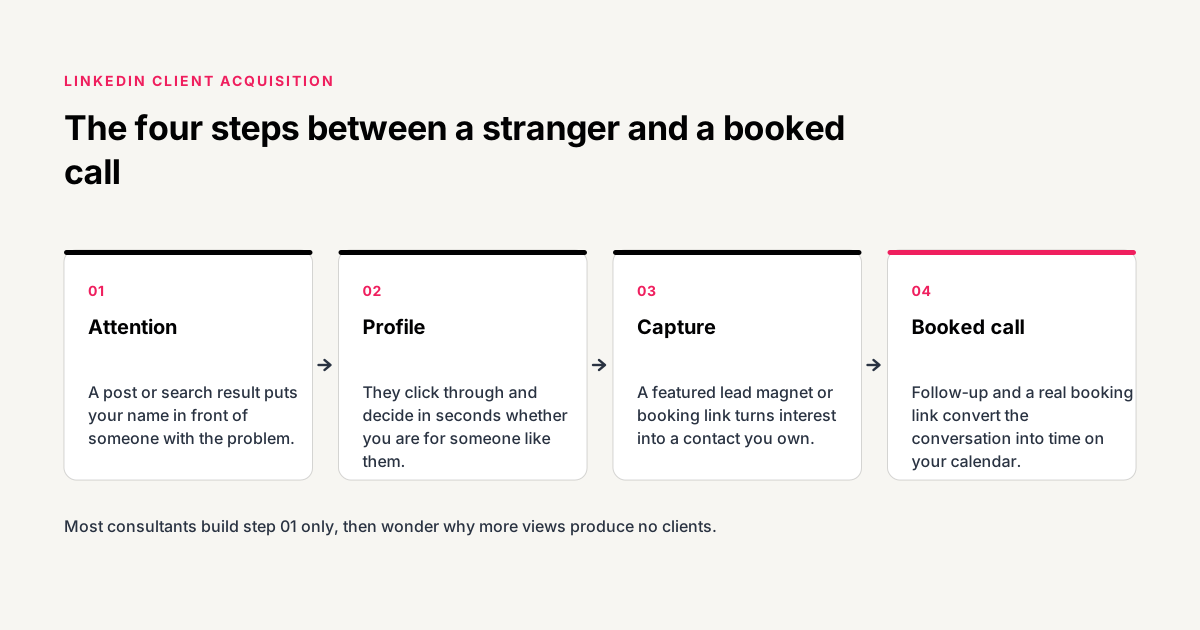
Here is the claim most people disagree with: your profile matters more than your content. Not because content is unimportant, but because of the order things happen in. Every post you have ever written sends interested people to the same profile. Fix the profile and you improve the return on every post you have already published, plus every post you write from now on. Write one more post and you have improved one post. The profile is the multiplier and it is usually the thing nobody touches.
What does your LinkedIn profile need to convert a visitor?
It needs to answer one question within about two seconds: is this person for someone like me? A visitor is not reading your career history. They are scanning for evidence that you solve their specific problem. Your headline, your banner and the first two lines of your about section carry almost all of that weight.
The headline is not your job title
The default headline is your role at your company, which tells a stranger nothing about what changes for them. Replace it with who you help and what result they get. "Fractional CFO" describes you. "I help SaaS founders get to a clean, investor ready set of books" describes them. The second one is searchable too, because buyers type problems into LinkedIn search, not job titles.
The about section leads with them, not you
LinkedIn truncates your about section after roughly three lines on mobile before showing a "see more" link. Everything that matters has to be above that fold. Open with the situation your buyer is in, name the outcome you produce, then let your credentials follow as proof rather than as the opening argument.
The featured section is your capture point
This is the part almost nobody uses properly. LinkedIn's Featured section lets you pin links directly under your about section, which makes it the single highest intent piece of real estate on your profile. Put your lead magnet there, or your booking page, or both. A visitor who has read this far is as warm as they will ever be, and most profiles give them nothing to do next.
| Element | Its job | Common mistake |
|---|---|---|
| Headline | Say who you help and what they get | Listing your job title and company |
| Banner | Reinforce the offer in one line | A stock photo of a city skyline |
| About section | Make the reader feel understood in 3 lines | Opening with your career story |
| Featured | Capture the warmest visitors | Left empty, or filled with old posts |
| Experience | Provide proof after interest exists | Treated as the main event |
If you only change one thing this week, change the featured section. It takes about ten minutes and it is the difference between a visitor who liked your profile and a contact you can actually follow up with. The mechanics of what to put there are covered in our guide to lead magnets that convert.
What should you post to reach buyers instead of peers?
Post about the problem, not about your process. Buyers search and engage with content that describes a situation they recognize. Peers engage with content about how the work gets done. Both get engagement, but only one brings in people who might hire you.
The practical test before you publish: could a potential client read this and think "that is exactly my situation"? If instead another consultant would read it and think "good technique", you have written a post for your competitors. That post will probably perform well, which is what makes this mistake so persistent.
Four post types that reach buyers
- The symptom post. Describe a specific problem in the buyer's own words, without naming the solution. "Your month end close takes eleven days and you still do not trust the number."
- The wrong assumption post. Name something your market believes that is costing them, then explain what is actually true.
- The teardown. Walk through a real example, anonymized if needed, showing what was broken and what changed.
- The decision post. Explain how to choose between two options your buyer is weighing, including when your service is the wrong answer.
Two or three posts a week is enough. Consistency matters more than volume, because the compounding effect comes from the same people seeing you repeatedly over months rather than from any single post reaching a large number of strangers once.
How do you find the right people to reach out to on LinkedIn?
Start with people who have already signaled interest, then work outward. The warmest lists are free and most consultants ignore them entirely in favor of cold search.
- Your post engagers. Anyone who liked or commented on a post about a problem you solve has raised their hand. Click through the reaction list on your last ten posts.
- Your profile viewers. People who visited your profile without connecting were interested enough to look. This list is visible on a free account for the last five viewers and in full with LinkedIn Premium.
- Second degree connections at target companies. Filter LinkedIn search by connection degree, job title and company size. A shared connection meaningfully raises reply rates.
- Commenters on your competitors' posts. People engaging with content about your problem space, publicly, on someone else's post. This list is large and almost nobody works it.
- Past clients and dormant conversations. Search your own message history for conversations that went quiet more than six months ago. Circumstances change.
Work these in order. The first two lists are small and convert far better than anything cold, which is why sending fifty cold connection requests before touching them is the wrong sequence.
What should you say in a LinkedIn outreach message?
Say something that could only have been written to that one person, and ask for a reply rather than a call. The first message has one job, which is starting a conversation. Asking for thirty minutes from a stranger fails because you are requesting the largest commitment at the point of least trust.
A message that works usually has three parts: a specific observation about them, a short relevant statement about what you see in their situation, and a low friction question. No pitch, no calendar link, no attachment.
The full set of templates, including connection requests and re-engagement messages, is in our guide to LinkedIn outreach messages that get replies. If you would rather have this run for you at volume without it sounding automated, that is what our outreach and DM systems service does.
How do you follow up without being annoying?
Follow up by adding something, not by asking again. The reason follow-ups feel annoying is that most of them repeat the original request in a slightly more apologetic tone. A message that contains something useful is a message that is welcome regardless of how many came before it.
A workable rhythm is three touches over about three weeks, then a long pause, then one re-engagement months later. Each touch carries something new: a relevant article, a specific observation, an offer of a resource. If there is no reply after the third, stop and move them to the dormant list rather than continuing.
The part almost everyone skips is what happens after someone downloads your lead magnet or replies once and goes quiet. Manual follow-up fails at exactly the volume where it starts to matter. This is where an email nurture sequence takes over, because it keeps following up indefinitely without you remembering to.
How do you turn a LinkedIn conversation into a booked call?
Make the call the obvious next step rather than a request. Once someone has described a problem to you in a message thread, the natural move is to offer a specific, bounded conversation about that problem. Bounded means they know exactly what it is and how long it takes.
"Want to jump on a call?" is vague and easy to postpone. "Happy to map out how I would approach the consolidation, takes about twenty minutes, here is my calendar" tells them the topic, the duration and the next action. Name all three and the acceptance rate changes noticeably.
Use a real booking link rather than negotiating times in the thread. Cal.com and Calendly both do this well. Every round of "does Tuesday work?" is another chance for the conversation to die, and scheduling by message is the most common place a warm lead goes cold.
How long does it take to get clients on LinkedIn?
Outreach produces conversations in the first two to three weeks. Content and follow-up compound over three to six months. Anyone promising client work in the first fortnight is describing outreach only, and outreach alone is the most fragile version of this because it stops producing the moment you stop sending.
The realistic sequence looks like this. Weeks one and two: profile rebuilt, capture point live, first outreach sent. Weeks three to six: conversations start, first calls booked from the warmest lists. Months two and three: content starts bringing people who were not on any list. Months four to six: inbound begins, because the same people have now seen you repeatedly and one of them finally has the problem.
| Part | First results | Keeps working after you stop? |
|---|---|---|
| Profile rebuild | Immediately | Yes, it is an asset |
| Outreach | 2 to 3 weeks | No, stops with you |
| Content | 2 to 3 months | Partly, older posts still surface |
| Lead magnet and capture | Weeks, then compounds | Yes |
| Email nurture | 1 to 3 months | Yes, runs indefinitely |
What does this look like for a real consultant?
Arunansu Pattanayak is a fractional CTO whose background includes Microsoft, KPMG and JPMorgan. His profile was not weak in the usual sense. The credentials were genuinely strong, which is precisely why the problem was invisible to him.
You can read the full client acquisition build we ran for Ed Perez Fitness for a longer version of the same pattern, in a different market. More client accounts are on the reviews page.
What are the most common LinkedIn mistakes consultants make?
- Optimizing for connections rather than conversations. A 10,000 person network of the wrong people produces less than 300 of the right ones.
- Pitching in the connection request. The highest volume way to be ignored permanently, and it burns the contact for later.
- Sending traffic to a profile with no next step. The most expensive mistake here, because you pay for it with work you already did.
- Posting only about your process. Reaches peers, feels successful, produces nothing.
- Treating replies as a to do list. Manual follow-up breaks down at around thirty open conversations, which is roughly where it starts to matter.
- Scheduling by message. Every exchange about timing is an opportunity for the lead to cool.
The pattern connecting all six is the same. Each one is a break between two steps that should hand off to each other. That is also why fixing them individually produces less than wiring them together, which is the argument for treating this as one client acquisition system rather than as six separate improvements.
Frequently asked questions
Do you need LinkedIn Premium to get clients?
No. Premium helps with two things: seeing your full profile viewer list and sending InMail to people outside your network. Both are useful, neither is required. The profile, content and outreach work described here all function on a free account, and most consultants should fix those before paying for Premium.
How many connection requests can you send per week?
LinkedIn limits most accounts to roughly 100 connection requests per week, and the limit tightens if your acceptance rate drops. This is a good constraint. It forces you to send to people who are likely to accept, which is the behavior that produces conversations anyway.
Should you post daily on LinkedIn?
Two or three times a week is sufficient for most consultants and far more sustainable. Daily posting only outperforms if you can hold the same quality, and quality drops for almost everyone. The compounding comes from the same buyers seeing you repeatedly over months, not from raw volume in any single week.
How long should a LinkedIn outreach message be?
Under 60 words for a first message. It should contain one specific observation about them and one answerable question. Anything longer reads as a pitch, and anything that includes a calendar link before a reply has been earned typically ends the conversation before it starts.
Does LinkedIn content still work in 2026?
Yes, though reach per post has fallen and the platform now favors content that keeps people on LinkedIn rather than sending them elsewhere. The practical adjustment is to put the full value in the post and place the capture point on your profile, rather than putting a link in the post body.
What if your buyers are not active on LinkedIn?
Check before you assume. Many buyers read without posting, so an empty activity feed does not mean absence. If your market genuinely is not there, LinkedIn is the wrong channel and the same four stage structure should be built somewhere your buyers actually are.
Published . Last updated . 2,747 words.