How does ChatGPT decide which businesses to recommend?
Two different mechanisms, and confusing them wastes a lot of effort. When ChatGPT searches the web to answer a question, it retrieves live pages and summarizes them. When it answers from memory, it draws on patterns in its training data. These respond to completely different work on completely different timescales.
Retrieval is the one you can influence quickly. If your site is readable and relevant, a search-backed answer can include you within weeks. Training-based recall changes only when a model is retrained, which happens on a schedule nobody outside the labs controls.
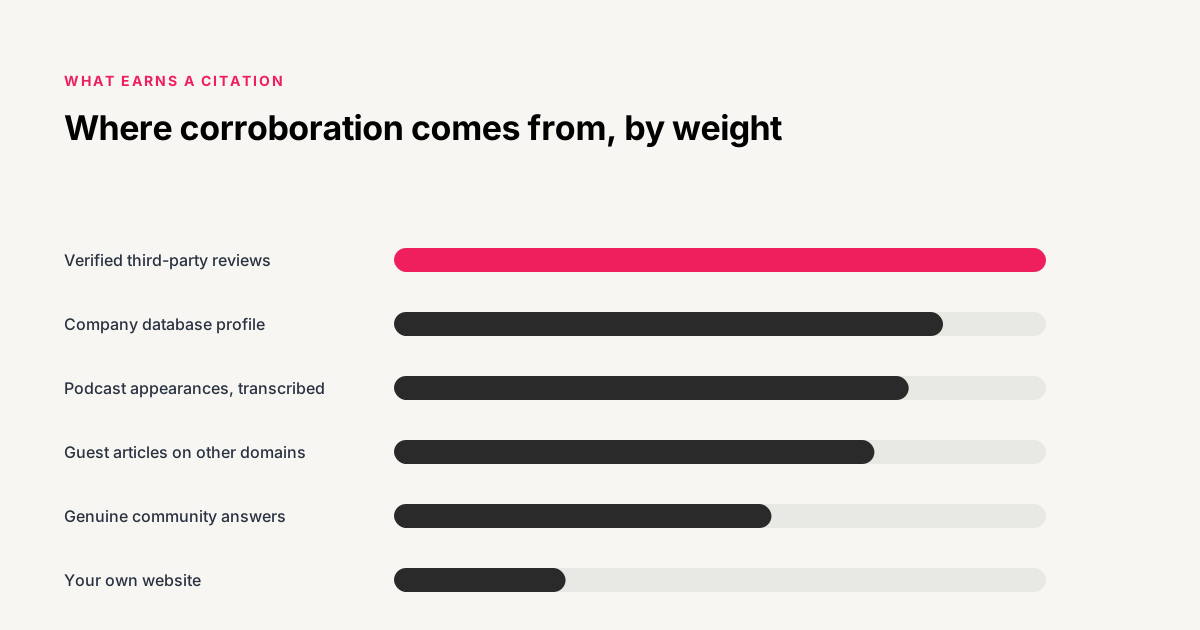
Both mechanisms share one bias, and it is the thing worth designing around. They favor businesses that multiple independent sources agree about. A company described identically on its own site, a review platform, a company database and two podcasts is safe to name. A company that exists only on its own domain is a claim with nothing behind it.
How do you make your site readable to ChatGPT's crawler?
Serve your content in the initial HTML response and let the crawlers in. OpenAI operates several agents with different jobs, and they need different permissions depending on what you want.
| Agent | What it does | Allow? |
|---|---|---|
| GPTBot | Collects data for model training | Yes, for long-term recall |
| OAI-SearchBot | Builds the search index used in answers | Yes, this drives citations |
| ChatGPT-User | Fetches a page when a user's question needs it | Yes, this is live retrieval |
Allow all three. Blocking GPTBot to protect your content from training also removes you from the recall that produces unprompted recommendations, which is usually the opposite of what a business wants.
Then verify what the crawler actually receives, because this is where most sites fail silently. Fetch your own page without a browser and count the visible text. A page that returns a few hundred characters when it displays two thousand words is rendering its content in JavaScript, and no non-JavaScript crawler will ever see it.
What entity data does an AI need to resolve who you are?
Enough to distinguish you from everyone with a similar name, and enough consistency that it does not have to choose between conflicting versions. Entity resolution happens before content retrieval. A model that cannot establish who you are will not repeat what you said.
- Publish an Organization node. Name, URL, founding date, description, location, contact details, and the topics you work on. This is the anchor everything else attaches to.
- Publish a Person node for each founder. With an explicit relationship to the organization. Without this, the founder's name and the company name stay unlinked, and questions about the person never surface the business.
- Cross reference by identifier. Have nodes point at each other by a stable identifier rather than repeating themselves. Repetition creates several loosely related entities instead of one well-described one.
- List every real external profile. This is the field that connects your site to your presence elsewhere, and it is the single most valuable one for entity resolution.
- Make one description canonical. Write one sentence describing the business and use it byte for byte on your site and on every external profile.
Step five sounds trivial and is not. Most companies have four slightly different self-descriptions across four platforms, all written at different times by different people. Each variation gives an engine another reason to be uncertain, and uncertainty resolves as silence rather than as a guess.
How do you build the corroboration that actually gets you named?
Get other people to publish that you exist and are good at something specific. This is the part that takes months and the part that decides the outcome. It cannot be done faster by improving your website.
Work in rough order of effect per hour spent. Start with the sources that are structured and verified, because those carry the most weight and require the least creativity.
- Verified review profiles. Ask existing happy clients to leave a review on a third-party platform. You almost certainly already have the testimonials. Moving them somewhere verified is what converts them into corroboration.
- A company database profile. Establishes that the entity exists independently of its own marketing. Low effort, one-time.
- Podcast appearances. Transcribed, indexed, and they attach your name to a topic in somebody else's voice. Small shows count.
- Guest articles. Attributed expertise published on a domain you do not control.
- Genuine answers in communities. Unpaid, contextual mentions where you actually help somebody. Slow, and unusually credible.
- Consistent professional profiles. Every platform where your business appears should describe it identically.
What should you publish to get quoted?
Answers to the questions your buyers actually ask, written so a single paragraph can be lifted out and still make sense. The unit of citation is the passage, not the page.
Start by writing down the ten questions you get on every discovery call. Those are the questions being typed into assistants right now. Each one becomes a section with the question as the heading and a complete answer in the first two sentences beneath it.
- Name yourself in the passage. Pronouns lose their referent the moment a paragraph is extracted.
- Answer first, elaborate second. An answer in sentence five is an answer that gets truncated away.
- Publish comparisons. Buyers ask engines to compare options constantly, and almost nobody writes an honest comparison including where they are the wrong choice.
- Publish your own data. Anything only you can measure makes you the only possible source for a whole class of question.
- Date your claims. A dated, attributed statement is safer to repeat than a confident undated one.
The mechanics of why this works are covered in more depth in our guide to generative engine optimization.
Does the same work apply to Perplexity and Gemini?
Mostly yes, with one useful difference in emphasis. All of them reward readable content, resolvable entity data and independent corroboration. What varies is how quickly each responds and what each leans on.
Perplexity is the most retrieval-heavy of the group. It searches live for almost everything and cites its sources visibly, which makes it the fastest place to see whether your technical work landed. If your site is readable and relevant, Perplexity will find you in weeks. Treat it as your early warning system.
Gemini and Google AI Overviews lean on Google's existing understanding of your site. That means conventional search hygiene carries over directly. A business Google already understands well is a business Gemini can describe. Your business profile matters more here than anywhere else, especially for anything local.
| Engine | Leans on | Prioritize |
|---|---|---|
| Perplexity | Live retrieval | Crawlable content, clear passages |
| ChatGPT | Retrieval plus recall | Both, plus corroboration over time |
| Gemini and AI Overviews | Google's index | Search hygiene, business profile |
| Claude | Retrieval plus recall | Consistent entity data |
The practical implication is that you do not need four strategies. Do the work once and check all four, because the underlying requirements overlap almost entirely.
What should you do in the first 90 days?
Front-load the things you control and start the slow things early. The technical work finishes. The corroboration work does not, so it needs to begin in week one rather than after everything else is perfect.
- Week 1, audit what a crawler sees. Fetch your key pages without a browser. Count the visible text. Fix anything that renders client-side before doing anything else.
- Week 1, unblock the crawlers. Check robots.txt and your CDN. Both. The CDN is where the surprise usually is.
- Week 2, fix your entity data. One canonical description. One founding date. Organization and Person markup that cross reference each other.
- Week 2, audit every external profile. Make every platform describe the business identically. This is free and it is the highest return hour in the whole plan.
- Weeks 3 to 6, ask for reviews. Go to clients who already said something kind and ask them to say it somewhere verified. You are not asking for a favor, you are relocating one.
- Weeks 4 to 12, publish answers. Ten questions from your discovery calls, each answered completely in the first two sentences under a question-shaped heading.
- Weeks 6 to 12, get on other people's platforms. Podcasts, guest articles, community answers. Small audiences count, because the citation matters more than the reach.
- Month 3, measure. Run your buyer questions three times each across all four engines and record how often you appear.
Weeks one and two are perhaps six hours of work in total. They will not get you recommended on their own. But skipping them makes everything after them worthless, because corroboration pointing at a site nobody can read is corroboration wasted.
How do you check whether ChatGPT recommends you?
Ask it, repeatedly, in a fresh session. Answers are not deterministic, so a single check tells you very little. Run each question three times with no chat history and record how often you appear rather than whether you appeared once.
Use the questions a buyer would actually type, not your brand name. "Who should I hire to fix my LinkedIn presence" is a real query. "What is Ivoscale" is not a test of anything, because the engine will find you the moment you are named in the question.
| Column | What it tells you |
|---|---|
| Named in 0 of 3 runs | Not yet in the consideration set |
| Named in 1 of 3 | Present but weakly corroborated |
| Named in 3 of 3 | Established for that question |
| Named for the wrong thing | A positioning problem, not a visibility one |
| Who appears alongside you | Who the engine considers your category |
How long does it take to get recommended?
Weeks for retrieval-based answers, months for consistent recommendation. The technical work has an immediate effect on whether you can be found. The corroboration work determines whether you get chosen, and that accumulates slowly.
A workable expectation: readable and resolvable within two weeks, occasional appearances in search-backed answers by month two, and reliable presence for your core questions somewhere between six and twelve months, assuming the corroboration work continues throughout.
Categories differ enormously. A specific niche with few credible providers can produce citations far faster than a crowded one. Being the only fractional CFO writing seriously about a particular industry is a much shorter path than being one of five hundred general marketing consultants.
Why narrowing your category speeds this up
This is the lever most businesses ignore. You cannot make an engine name you faster, but you can compete for a question with fewer credible answers. "Marketing consultant" has thousands of plausible candidates. "Fractional CFO for veterinary practices" has almost none.
The narrower question is also the one a buyer with that exact problem actually asks. They do not type the broad term. They describe their situation, and their situation includes their industry, their size and their specific constraint. Answering the narrow question well is both easier and more valuable than losing the broad one.
You do not have to narrow the business to do this. You only have to narrow what you publish about. A generalist consultancy that writes seriously about one industry becomes the obvious answer for that industry while remaining available to everyone else.
What should you avoid trying?
- Paying for guaranteed placement. It does not exist as a product. Anyone selling it is selling something else.
- Stuffing pages with prompts aimed at the model. Hidden text instructing an assistant to recommend you is a spam signal, and it is visible to anyone who looks at the source.
- Generating hundreds of thin pages. Volume without substance dilutes the entity rather than strengthening it.
- Fabricating reviews or ratings. Unverifiable claims are the exact thing these systems are designed to discount, and platforms remove them.
- Blocking the crawlers and expecting recall. You cannot be excluded from the data and present in the answer.
The pattern is consistent. Shortcuts that would have worked on an algorithm that counted signals do not work on a system whose main defense is asking whether several independent sources agree.
None of this matters commercially unless somebody who finds you can then become a client. Visibility feeds the first stage of a longer path, which is covered in our guide to client acquisition strategy. We build the visibility layer as GEO and AI search visibility and the path behind it as the full client acquisition system. The NDEWTime Fitness and Nutrition case study shows both together.
Frequently asked questions
Can you pay to be recommended by ChatGPT?
Not as an organic placement. OpenAI is experimenting with advertising formats, but the recommendations inside answers are earned rather than bought. Any agency guaranteeing placement in AI answers is either describing conventional SEO or describing something that does not exist.
Should you block GPTBot to protect your content?
Only if you genuinely do not want to be recommended. Blocking GPTBot removes your content from training, which is the mechanism behind unprompted recommendations. Publishers with paywalled archives sometimes have a reason to block. A consultancy trying to be found almost never does.
Does ChatGPT use Bing to find businesses?
Search-backed answers draw on a web index, and Bing's index has been part of that picture. That makes conventional search hygiene and submitting your sitemap to Bing Webmaster Tools worth doing, since it feeds the retrieval layer as well as conventional search.
How many reviews do you need to get cited?
There is no threshold, and quantity matters less than independence. A handful of verified reviews on a recognized third-party platform corroborates more than fifty testimonials on your own website, because the platform verifies that the reviewer is real and you do not.
Does having a bigger website help?
Not by itself. A hundred thin pages dilute an entity, while ten pages that answer real questions completely strengthen it. What helps is depth on the specific things you want to be known for, plus consistency across everywhere you appear.
Will this work for a brand new business?
It takes longer, because there is nothing yet for anyone to corroborate. Start with the entity data and the third-party profiles, since a new business can establish those within days, then build citations over the following months. Being early in a narrow category is a real advantage.
Published . Last updated . 2,677 words.