Why does cold calling fail for fractional executives?
Because the purchase is triggered by a specific internal event, and cold outreach has almost no chance of coinciding with it. A founder does not decide to hire a fractional CFO because somebody rang them. They decide because the board asked a question they could not answer.
That timing problem is the whole difficulty. At any given moment perhaps two percent of your addressable market is actively looking. Cold calling reaches the other ninety-eight percent at considerable effort and leaves no residue, since a founder who was not ready in March does not remember your name in September.
There is a second reason, and it is about positioning. Cold calling signals available capacity. For a role that is fundamentally about judgment, the perception of scarcity does real commercial work, and outbound volume quietly undermines it.
Where do fractional CFO clients actually come from?
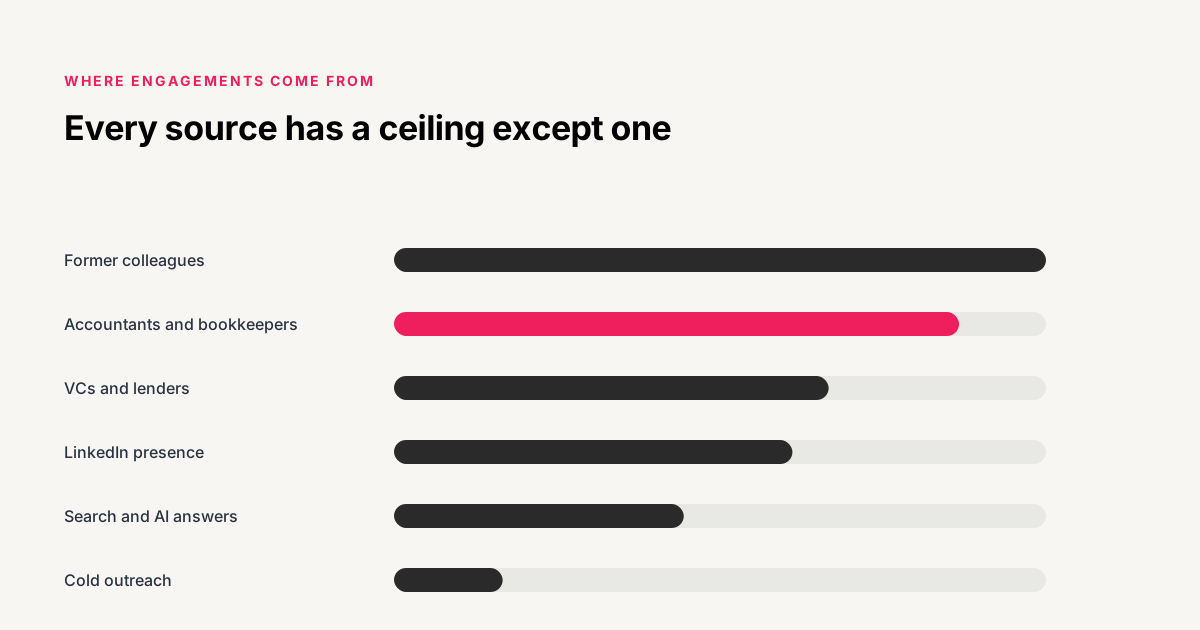
Overwhelmingly from referral and reputation early on, then from a much wider mix once somebody deliberately builds one. The pattern is consistent enough to be predictable, and so is where it stalls.
| Source | Strength | Ceiling |
|---|---|---|
| Former colleagues | Highest trust, shortest cycle | Fixed size, depletes |
| Accountants and bookkeepers | Sees the trigger event first | Requires active cultivation |
| VCs and lenders | Introduces at exactly the right moment | Hard to access early |
| LinkedIn presence | Reaches founders directly, compounds | Slow to start |
| Search and AI answers | Highest intent of any source | Requires published content |
| Cold outreach | Predictable volume | Poor timing fit, no residue |
The second row is the one most fractional CFOs underuse. Accountants and bookkeepers encounter the trigger event before anyone else does, because they are the ones telling a founder that this is now beyond what they cover. Being the person that accountant thinks of is worth more than any amount of direct outreach to founders.
Why do referrals stop being enough?
Because the network that produces them is a fixed size and each referral consumes some of it. A fractional CFO leaving a corporate role typically has enough relationships to fill two or three engagements, which feels like validation that referrals work. They do work. They just do not renew at the rate they are spent.
The failure mode is delayed and therefore easy to miss. Everything is comfortable for eighteen months. Then two engagements end in the same quarter, the network has already been worked, and there is no pipeline because nothing was ever built to produce one. Starting then means starting from zero at the exact moment revenue drops.
Which is why the correct time to build the system is while referrals are still working. That is also when nobody feels any urgency to do it, and the reason this pattern repeats across almost every fractional practice.
What actually triggers a founder to hire a fractional CFO?
A specific, nameable event that makes the current arrangement visibly insufficient. Knowing these matters because your content should describe the event rather than the service. Founders search for the problem they are having, not for the job title that solves it.
- A funding round closes. New reporting obligations arrive immediately and the existing setup cannot meet them.
- The board asks a question nobody can answer. Usually about runway, unit economics or a variance nobody can explain.
- Month end close takes too long. When it stretches past two weeks, the numbers are stale before anyone reads them.
- A bank or lender requires forecasts. Suddenly there is an external party with standards.
- Headcount crosses a threshold. Payroll complexity and cash planning become genuinely difficult somewhere around twenty to thirty people.
- A finance hire leaves. Immediate gap, immediate urgency, and the shortest sales cycle of any trigger.
Each of those is a content topic and a search query. "Our month end close takes three weeks" is what a founder types. "Fractional CFO services" is what a fractional CFO writes about, and the mismatch between those two is why so much of this content reaches nobody.
What does an inbound system look like for a fractional CFO?
Four connected pieces, none of which involve calling anyone. Each addresses a different part of the timing problem, which is that you need to be present before the trigger and reachable after it.
- A profile that names the trigger, not the title. Your headline should describe the situation a founder is in. "Fractional CFO" tells them your job. "I get post-raise finance functions to a clean close in 90 days" tells them whether you are for them.
- Content about the events, published consistently. Write about the stalled close, the board question, the runway model nobody trusts. Two or three times a week, indefinitely.
- A capture point with genuine utility. A model, a close checklist, a board pack template. Something a founder would actually use, which also demonstrates competence better than describing it would.
- Follow-up that runs for months. Somebody downloading a runway model today may not have the trigger for eight months. An automated sequence is the only realistic way to still be present then.
The fourth item is where most fractional practices lose the majority of their opportunity. The sales cycle for this work is genuinely long, and manual follow-up does not survive a busy client month. The mechanics are in our guide to the B2B email nurture sequence, and the wider structure is in our guide to client acquisition strategy.
How should a fractional CFO use LinkedIn specifically?
Post about financial decisions rather than financial expertise. The distinction determines who reads it. Expertise content reaches other finance professionals, who are peers rather than buyers. Decision content reaches founders, who are the people with the budget.
Arunansu Pattanayak, a fractional CTO with a background at Microsoft, KPMG and JPMorgan, ran into precisely this with his profile rather than his content. Strong credentials, organized around his career, generating no enquiries. After the rebuild his words were: "Now I get leads just from profile and post interaction." The full mechanics are in our guide to LinkedIn profile optimization.
What should a fractional CFO actually publish?
Write about the decisions founders make badly. Not because they are careless. Because nobody has explained the tradeoff to them in language that does not assume a finance background.
You already know what these are. They come up on every engagement in the first month, and you have explained each one dozens of times. That repetition is the signal. Anything you have explained more than five times is a piece of content, and you can write it faster than anything you would have to research.
- When to hire finance in-house. Founders ask this constantly and get answers from people with an interest in the outcome.
- Why profit and cash diverge. The single most common founder confusion, and the one that causes the most damage.
- What a board actually wants to see. Most first-time founders are guessing, and it shows in the pack.
- How long a close should take. Nobody knows the benchmark, so nobody knows theirs is bad.
- Which metrics matter at each stage. The list changes, and using last stage's metrics is common.
- What a raise does to your reporting obligations. Reliably underestimated until the first board meeting.
One format outperforms all the others here, and it is the one most professionals avoid. Publish your own numbers. Not client numbers, which you cannot share, but anonymized patterns across your engagements. How long a close typically takes at thirty people. What proportion of post-raise companies have a runway model they trust. Nobody else has that data, which makes you the only possible source for a question a founder genuinely wants answered.
How do you build referral relationships that produce work?
Be specifically useful to the people who meet your buyer before you do, and be specific about what you take. Accountants, bookkeepers, corporate lawyers and fundraising advisors all encounter the trigger event as part of their normal work.
The mistake is asking generally for referrals. "Let me know if anyone needs a CFO" is unmemorable, because it gives the other person nothing to pattern match against. "If a client's month end close is taking more than two weeks after a raise, that is exactly what I fix" is a trigger somebody can actually recognize when it appears in front of them.
Reciprocity should be real rather than transactional. Send work back where you genuinely can, and answer their technical questions without invoicing for it. A bookkeeper who trusts your judgment will refer for years, and that relationship is worth considerably more than any single engagement.
Why bookkeepers refer more than accountants
It is worth understanding the difference, because most fractional CFOs court the wrong one. Accountants are frequently perceived by the founder as already covering finance, which makes a referral feel like an admission that something was missing. Bookkeepers have no such conflict. They see the daily reality, they know exactly where their remit ends, and they are usually relieved when somebody senior takes on the questions they are being asked but not paid to answer.
There is also a volume argument. A single bookkeeper may work across fifteen or twenty small companies simultaneously, which is a considerably wider view of trigger events than any individual accountant relationship provides. Three good bookkeeper relationships can produce more qualified introductions than a much larger network of founders, because they encounter the moment rather than experiencing it.
Make it easy for them. Give them one sentence they can repeat verbatim, and make sure it describes a situation rather than a service. Anything requiring them to explain what a fractional CFO is will not get said, because nobody wants to deliver a definition on somebody else's behalf in the middle of their own client meeting.
Should fractional CFOs care about AI search?
More than most professions, because of how their buyers behave. A founder hiring a fractional CFO for the first time does not know what good looks like, what the arrangement should involve, or what it should reasonably require. So they ask an assistant, and increasingly they ask before they search.
That is an unusually favorable position. The buyer is uncertain, the category is unfamiliar to them, and there is no dominant default provider, which are precisely the conditions where an answer engine's recommendation carries the most weight.
The requirements are covered in our guides to generative engine optimization and getting recommended by ChatGPT. The short version is that you need content an AI crawler can read, entity data that resolves consistently, and independent sources that corroborate your existence. We build that layer as GEO and AI search visibility.
How long before an inbound system replaces referrals?
Six to twelve months to become the primary source, assuming consistent work throughout. That is slower than most people want and it is the honest answer for a purchase with this trigger structure and this sales cycle.
The compensating property is that it does not deplete. A referral network of forty people produces a finite number of introductions. A system that reaches founders at the moment their close breaks keeps working as long as founders keep having that problem, which they will.
Building it while referrals are still comfortable is the entire argument. The NDEWTime Fitness and Nutrition case study documents the same shift in a different profession, from manual prospecting to a system that books pre-screened calls, and the full client acquisition system is what we build and then operate monthly.
One practical note on sequencing. You do not need all of this running before it starts helping. The capture point and the follow-up can be live within a fortnight, and they immediately change what happens to the traffic your existing reputation already generates. Content and search visibility then compound behind them over the following months, which is the slower half.
Frequently asked questions
How many clients can a fractional CFO handle?
Typically three to six concurrent engagements, depending on depth and whether any are in an intensive phase. That ceiling is why acquisition matters differently here than in a scalable business: you are not trying to generate unlimited demand, you are trying to have a qualified replacement ready when an engagement ends.
Should you niche down as a fractional CFO?
Yes, and by trigger or stage rather than only by industry. "Post-Series A SaaS" is more useful than "technology" because it describes a specific financial situation with predictable problems. It also makes you far easier for an AI assistant to recommend, since a narrow question has fewer credible answers.
Do you need a website as a fractional CFO?
Yes, though it can be small. Three or four pages is sufficient: what you do, who for, proof, and a way to book. Its main jobs are being the destination your profile and content point at, and being the source an AI engine reads when somebody asks about you.
How do you price fractional CFO work?
Monthly retainers based on scope and time commitment are the norm, with project fees for defined pieces like a fundraise or a systems migration. Hourly pricing is generally worth avoiding, since it prices your judgment by the minute and invites clients to ration access to the thing they hired you for.
Is LinkedIn better than a newsletter for fractional executives?
Do both, and treat them as different stages. LinkedIn creates reach among people who do not yet know you. A newsletter maintains presence with people who already do. LinkedIn without a capture point is reach that evaporates, which is the most common structural gap in fractional marketing.
What if you have no content and no audience yet?
Start with the capture point and the follow-up rather than with content. Work the relationships you already have, including former colleagues and accountants, and let those produce the first engagements while content compounds in the background over the following months.
Published . Last updated . 2,601 words.